Liturgy of the Hours
The Liturgy of the Hours
Many Catholics assume the Divine Office is only for clergy and religious. While priests and deacons are obligated to pray it, the Church repeatedly encourages the laity to take part as their circumstances permit.

Liturgy of the Hours:
The Liturgy of the Hours, also known as the Divine Office, is the official daily prayer of the Catholic Church outside of the Holy Mass. Through the Psalms, Scripture readings, hymns, and intercessions, the Church sanctifies the different hours of each day, offering continual praise to God.
For centuries, priests, deacons, monks, nuns, and religious communities have prayed the Hours. Today, the Church warmly invites all the faithful to participate in this beautiful tradition.
"Seven times a day I praise you." (Psalm 119:164)
The Liturgy of the Hours is not merely a private devotion. It is the prayer of Christ united to His Church. When we pray the Hours, we join a worldwide chorus of praise rising from every nation and time zone.
The Church teaches that after the Holy Mass, the Liturgy of the Hours is the most important public prayer of the Church. Through it we:
- Pray with the very words of Scripture.
- Unite ourselves to the prayer of Christ.
- Join the universal Church in continuous worship.
- Sanctify the ordinary moments of daily life.
- Grow in familiarity with the Psalms and the Bible.
- Deepen our participation in the liturgical life of the Church.
A Prayer for Everyone
On August 5, 2026, Pope Leo XVI spoke at a the General Audience and said, “Every week and every day, the Eucharist and the Liturgy of the Hours are the breath of the life of the Church, which makes the Holy Spirit circulate through her Body."
Bound to the Eucharist, the Liturgy of the Hours sanctifies the rhythm of the day, the pope said, beginning with morning prayer, continuing at midday and evening, and ending with night prayer as the faithful entrust themselves to God's peace.
"Each hour is an act of hope," he said.
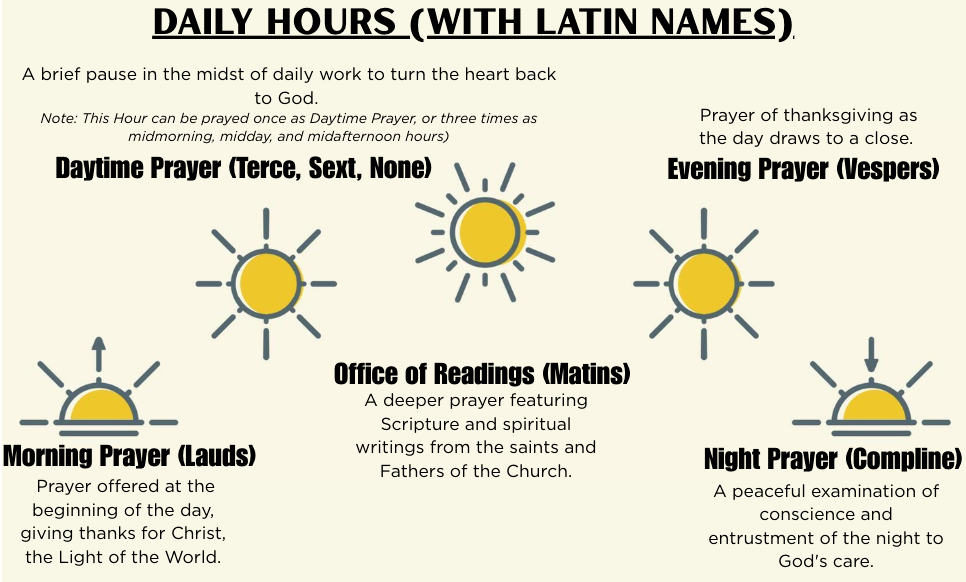
The principal hours (with traditional Latin names), are
- Office of Readings (Matins) - A deeper prayer featuring Scripture and spiritual writings from the saints and Fathers of the Church.
- Morning Prayer (Lauds) - Prayer offered at the beginning of the day, giving thanks for Christ, the Light of the World.
- Daytime Prayer (Terce, Sext, None) - A brief pause in the midst of daily work to turn the heart back to God. Note: This Hours can be prayed once as Daytime Prayer, or three times as midmorning, midday, and midafternoon hours)
- Evening Prayer (Vespers) - Prayer of thanksgiving as the day draws to a close.
- Night Prayer (Compline) - A peaceful examination of conscience and entrustment of the night to God's care.
Bonus History Lesson!
The Catholic Church did not invent the Liturgy of the Hours. Rather, it inherited and developed a pattern of daily prayer that was already deeply rooted in the Jewish faith. Long before the birth of the Church, faithful Jews sanctified the day by praying at fixed times, especially in connection with the Temple sacrifices and the recitation of the Psalms.
The Apostles continued this practice after the Resurrection. Scripture records Peter and John going to the Temple for prayer at the appointed hour (Acts 3:1), and Peter praying around noon (Acts 10:9). The early Christian community, composed largely of Jewish believers, naturally carried these customs into the life of the Church. As Christianity spread, the hours of prayer became centered on Christ while retaining their biblical and Jewish foundations.
As our parish seeks to grow in holiness and discipleship, let us answer the Church's invitation to "pray without ceasing" (1 Thessalonians 5:17). Through the Liturgy of the Hours, the rhythm of prayer can transform ordinary days into a continual offering of praise to God.
"The Divine Office... is truly the voice of the Bride herself addressed to her Bridegroom; it is the very prayer which Christ Himself, together with His Body, addresses to the Father."
— Second Vatican Council, Sacrosanctum Concilium 84