WHY THE ORANS POSTURE BELONGS TO THE PRIEST AT MASS
Why The Orans Posture Belongs to the Priest at Mass
From time to time, it is good for us as a parish family to pause, reflect, and make sure our liturgical practices truly reflect what the Church asks of us. None of us is ever “finished” learning the liturgy; we grow together in fidelity, humility, and love for the sacred mysteries.
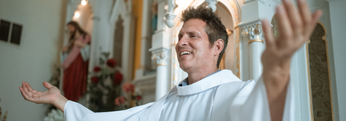
The Church gives the priest certain gestures (called presidential gestures) that belong uniquely to his role as the one who presides and offers the Mass in Persona Christi Capitis. One of these is the Orans posture — the raising of the hands in prayer. This gesture belongs to the presider, not to the assembly, including during the Our Father.
For the faithful, the Church intentionally assigns no gesture during the Our Father in the General Instruction of the Roman Missal. This is not an omission and is covered in Canon Law and Ecclesiae de Mysterio.
It is a sign of unity: we pray with one voice, standing together, but we do not imitate the gestures that express the priest’s sacramental role.
So, out of love for the Liturgy and respect for the distinct vocations within the Body of Christ, the faithful are asked not to use the Orans posture at Mass. Our reverence is shown not by copying the priest, but by embracing the posture the Church gives us — standing together, hearts lifted, voices united and sending our prayers through the priest.
This is not an admonishment but an invitation: to let the priest be the priest, to let the Liturgy speak in its own language, and to let our unity be expressed in the way the Church herself teaches.
When is the Orans Posture Appropriate for the Deacon and the Laity?
FOR THE DEACON:
When a deacon is serving as presider, he may rightly use the orans posture.
This includes celebrations such as: Sunday Celebrations in the Absence of a Priest, Liturgy of the Word with or without Holy Communion, The Liturgy of the Hours. In these moments, the Deacon is entrusted with presiding over the assembly in prayer, and the Church gives him the gestures that express that role.
FOR THE LAY FAITHFUL:
During Mass, the orans posture is not assigned to the laity, who instead pray with the simplicity and beauty of hands joined. However, outside of Mass, the faithful may certainly use the orans posture in: private prayer and devotions, such as family prayer within the home. In the domestic church — the family — the one who leads prayer (often a father or mother) takes on the role of presider for that moment, and may use the orans posture as a natural expression of leading their household in prayer.
References
Code of Canon Law
907
In the Eucharistic celebration, Deacons and lay persons are not permitted to offer prayers, especially the Eucharistic Prayer, or to perform actions which are proper to the celebrating priest.
General Instruction of the Roman Missall
(Third Edition)
(42b) A common bodily posture, to be observed by all those taking part, is a sign of the unity of the members of the Christian community gathered together for the Sacred Liturgy.
(43b) For the sake of uniformity in gestures and bodily postures during one and the same celebration, the faithful should follow the instructions which the Deacon, a lay minister, or the Priest gives, according to what is laid down in the Missal.
Ecclesiae de Mysterio (1997)
Article 6 §2
To promote the proper identity (of various roles) in this area, those abuses which are contrary to the provisions of canon 907 are to be eradicated...neither may deacons or non-ordained members of the faithful use gestures or actions which are proper to the same priest celebrant. It is a grave abuse for any member of the non-ordained faithful to "quasi preside" at the Mass while leaving only that minimal participation to the priest which is necessary to secure validity. To avoid any confusion between sacramental liturgical acts presided over by a priest or deacon, and other acts which the non-ordained faithful may lead, it is always necessary to use clearly distinct ceremonials, especially for the latter.