Solemnity of Our Lord Jesus Christ, King of the Universe
Christ the King
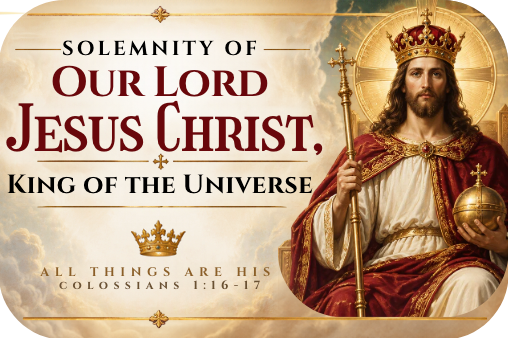
On the last Sunday of each liturgical year, the Church celebrates the Solemnity of Our Lord Jesus Christ, King of the Universe, or Christ the King. Pope Pius XI instituted this feast in 1925 with his encyclical Quas primas (“In the first”) to respond to growing secularism and atheism. He recognized that attempting to “thrust Jesus Christ and his holy law” out of public life would result in continuing discord among people and nations. This solemnity reminds us that while governments come and go, Christ reigns as King forever.
Pope Pius XI’s encyclical gave Catholics hope and—while governments around them crumbled—the assurance that Christ the King shall reign forever. Jesus Christ “is very Truth, and it is from Him that Truth must be obediently received by all mankind” (Quas primas, 7).
Christ’s kingship is rooted in the Church’s teaching on the Incarnation. Jesus is fully God and fully man. He is both the divine Lord and the man who suffered and died on the Cross. One person of the Trinity unites himself to human nature and reigns over all creation as the Incarnate Son of God. “From this it follows not only that Christ is to be adored by angels and men, but that to him as man angels and men are subject, and must recognize his empire; by reason of the hypostatic union Christ has power over all creatures” (Quas primas, 13).
The Church calls us to acknowledge Christ’s kingship with our whole lives:
- He must reign in our minds, which should assent with perfect submission and firm belief to revealed truths and to the doctrines of Christ.
- He must reign in our wills, which should obey the laws and precepts of God.
- He must reign in our hearts, which should spurn natural desires and love God above all things, and cleave to him alone.
- He must reign in our bodies and in our members, which should serve as instruments for the interior sanctification of our souls, or to use the words of the Apostle Paul, ‘as instruments of justice unto God.’ -Quas primas, 33
Today, religious freedom for many people means that we can believe whatever we want in private, but when we enter the public square or the marketplace, we may not speak of anything that relates to our faith. However, the Church acknowledges the reign of Christ, not only privately, but publicly. This solemnity encourages us the celebrate and live out our faith in public. “Thus by sermons preached at meetings and in churches, by public adoration of the Blessed Sacrament exposed and by solemn processions, men unite in paying homage to Christ, whom God has given them for their King” (Quas primas, 26).
When we celebrate the Solemnity of Christ the King, we declare to the world and
remind ourselves that Jesus is the Lord of the Church and of the entire universe.
Things You May Not Know About the Solemnity of Christ the King
It is one of the Church’s newest Solemnities
The feast was established by Pope Pius XI in 1925 through the encyclical Quas Primas. He instituted it in response to growing secularism and the tendency of societies to push God to the margins of public life.
It wasn’t always celebrated in November
Originally, the feast was observed on the last Sunday of October. After the liturgical reforms following the Second Vatican Council, it was moved to the final Sunday of the liturgical year, immediately before Advent.
It is the Church Year's "Grand Finale"
The Liturgical Year Begins with Anticipation at Advent and Ends with Christ Reigning as King over all Creation. Before we begin waiting for Christ's Coming at Christmas, we celebrate the truth that He already reigns and will return in glory.
The title "King of the Universe" is unique
The Church deliberately does not call Him merely "King of the World." The title emphasizes that Christ's authority extends over all creation: heaven and earth, time and eternity, angels and humanity, the visible and invisible universe.
The feast is a reminder that Christ’s kingdom is bigger than politics.
Pius XI taught that governments, nations, and earthly rulers come and go, but Christ remains King forever. The solemnity proclaims that ultimate authority belongs not to any political system, but to Jesus Christ.
Christ's crown is a crown of thorns
One of the most profound paradoxes of the feast is that the King we celebrate conquered not by military power but through sacrifice. The Gospel readings often connect Christ's kingship with the Cross, reminding us that His throne was Calvary. This is a kingdom built on truth, mercy, and self-giving love.
The feast asks a personal question
The celebration is not simply about acknwledging that Jesus is King in theory. The deeper question is: If Christ is King of the Universe, is He King of my life? Pope Pius XI taught that Christ should reign in our minds, wills, hearts, and actions.